Following months of budget negotiations and adjustments, Jersey City has issued final tax bills that reflect a 13.8% net annual increase in the total property tax rate. The Jersey City Council officially approved a 15% increase to the municipal portion of the city’s property tax on Wednesday, August 26, 2026, in an 8–0 vote.
While the Council only controls the city’s portion of the budget, the municipal increase serves as the final piece of Jersey City’s 2026 property tax picture. When combined with the previously established levies for the Hudson County government and the Jersey City Board of Education, property owners are facing a 13.8% total net increase on their overall tax bills for the year.
For commercial owners, this increase has important implications for operating budgets, cash flow, and the evaluation of future property tax appeals.
Understanding the 2026 Property Tax Increase
A Jersey City property tax bill consists of three primary components:
- Municipal Tax Levy: The City’s portion will increase by 15%. The increase is driven largely by the City’s substantial structural budget deficit. The City initially faced a deficit of approximately $255 million and subsequently reduced the proposed tax increase following state financial assistance and significant spending cuts.
- Board of Education Tax Levy: The school tax component, which represents the largest share of the property tax bill, is expected to increase by approximately 15%.
- Hudson County Tax Levy: The County component is expected to increase by approximately 11% for Jersey City properties.
Because these components represent different portions of the overall tax bill, their combined effect results in an estimated 13.8% net increase in Jersey City property taxes for 2026.
What the Rate Increase Means for Your Next Bill
The increase will not be reflected evenly across the four quarterly tax bills. Because Q1 and Q2 were already billed at the lower 2025 rate (2.335), the uncollected balance is compressed into the second half of the year:
- Q3 Rate: Rises to 2.648
- Q4 Rate: Rises to 2.657
This catch-up mechanism means that Q3 and Q4 bills may be approximately 27%–28% higher than the Q2 bill, depending on the property’s assessed value. While this creates a temporary surge in the second half of the year, the overall projected 2026 annual increase nets out to 13.8%.
Why Commercial Owners Should Act Now
Jersey City has made an online calculator available to help taxpayers estimate the impact on their individual properties. Use the City’s property tax calculator to estimate your projected 2026 tax liability and begin assessing the financial impact on your property.
“Commercial property owners should be looking at their 2026 budgets now, but they should also be looking ahead to 2027,” said David Wolfe, Co-Managing Partner of Skoloff & Wolfe, P.C. “This is an important time to evaluate whether the property’s assessment continues to reflect its true value and whether there may be a basis for a tax appeal.”
A higher tax bill does not, by itself, establish grounds for an appeal. But for income-producing commercial properties, a careful review of the assessment, income and expenses, market conditions, and other valuation data can help determine whether an assessment may be excessive.
Putting the Increase into Historical Context
Notably, this is not the first time that the City has experienced two years of anomalous spikes in its general tax rate over a four-year period. Jersey City’s tax rate increased 12.4% and 15% in 2006 and 2010, respectively, a pattern that closely mirrors the spikes in 2022 and 2026. The following charts summarize the historic Jersey City tax rates in the Pre- and Post-Revaluation Eras and the Transition interim period.
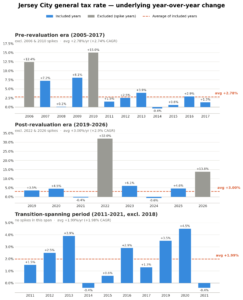
Excluding the spike years, the average annual changes in both eras have been approximately 3%. Moreover, in the interim period, between the spike years, the average annual change was 1.99%.
Although the long-term historic averages demonstrate relative consistency outside the anomalous years, taxpayers should be alert to the lumpy nature of the increases and plan accordingly.
Is Now the Time to Consider a Property Tax Appeal?
Given the magnitude of the increase, now is an appropriate time to engage qualified property tax counsel and begin that analysis, rather than waiting until the next filing deadline. An early review can help identify potentially overassessed properties, assemble the necessary financial information, and determine whether an appeal may be warranted.
Why Experienced Property Tax Counsel Matters
Navigating a property tax appeal requires more than simply determining that a property may be overassessed. Experienced legal counsel can help commercial property owners evaluate the merits of an appeal, develop the appropriate valuation strategy, meet applicable filing deadlines, and navigate the procedural and evidentiary requirements of the appeal process.
Contact us to review your Jersey City real estate holdings and to discuss the potential for a property tax appeal.
Skoloff & Wolfe, P.C., is well-versed in the area of property tax law. The Tax Department has litigated the value of virtually every type of commercial, industrial, and multi-family property. Our attorneys also frequently counsel clients regarding property tax exemption matters, long-term abatements, and PILOTs. Our clients include developers, management companies, financial institutions, REITs, hospitals, universities, religious institutions, private equity firms, and insurance companies.